When popular history recalls children associated with the Tower of London, it almost invariably remembers the tragic mystery of the Princes in the Tower, Edward V and Richard, Duke of York, who vanished behind its formidable stone walls in 1483. Yet less than a century later, during the early reign of Queen Elizabeth I, the ancient royal fortress served as a birthplace for two boys of legitimate Tudor blood: Edward Seymour, Lord Beauchamp (born in September 1561), and his younger brother, Thomas Seymour (born in February 1563).
Born to Lady Katherine Grey, the granddaughter of Mary Tudor (sister to King Henry VIII) and younger sister of the executed Nine Days Queen, Lady Jane Grey, these two boys represented both an immediate dynastic threat to Queen Elizabeth I and a poignant testament to the hazards of royal ancestry in sixteenth-century England.
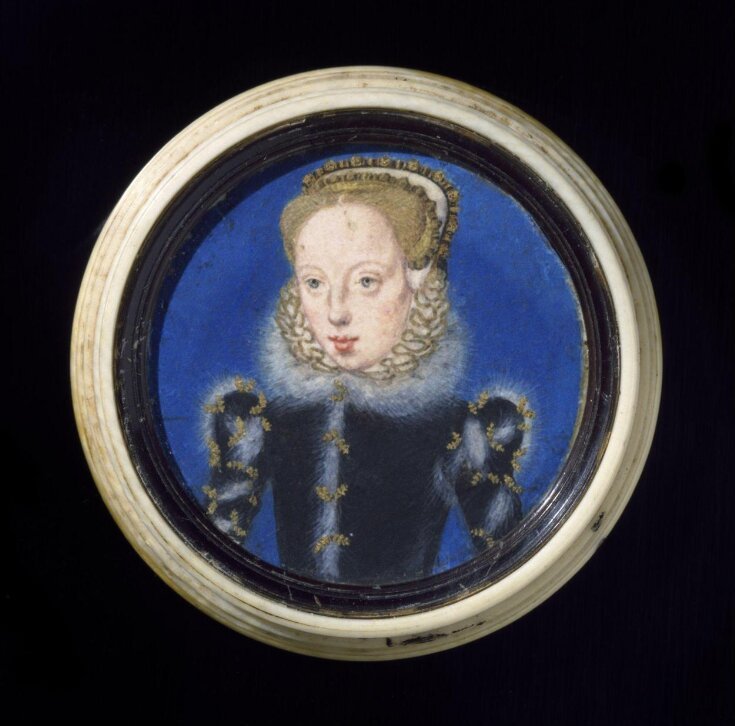
Portrait Miniature of Katherine Grey, Countess of Hertford Portrait Miniature ca. 1555-1560
The Clandestine Union and Royal Wrath
The arrival of these two children within a state prison was the direct consequence of a high-stakes secret romance. Following the tragic downfall and execution of her sister Jane in 1554, Lady Katherine Grey stood as the senior heir presumptive to the English throne under the strict terms of Henry VIII’s last will and testament. In late 1560, Katherine secretly married Edward Seymour, 1st Earl of Hertford, the son of the former Lord Protector Somerset.
In Elizabethan England, marrying a potential claimant to the English crown without the explicit license of the monarch was an act of severe insubordination. As biographer Conor Byrne emphasizes, the statutory precedent governing such actions was unmistakable:
“The Treason Act of 1536 had ruled that ‘It shall be high treason for any man to espouse, marry or take to his wife’ a relative of the monarch ‘or to deflower any of them being unmarried’ without having been granted ‘the King’s licence … under the great seal’, and the Act also held that ‘the woman so offending shall incur the like danger.'”
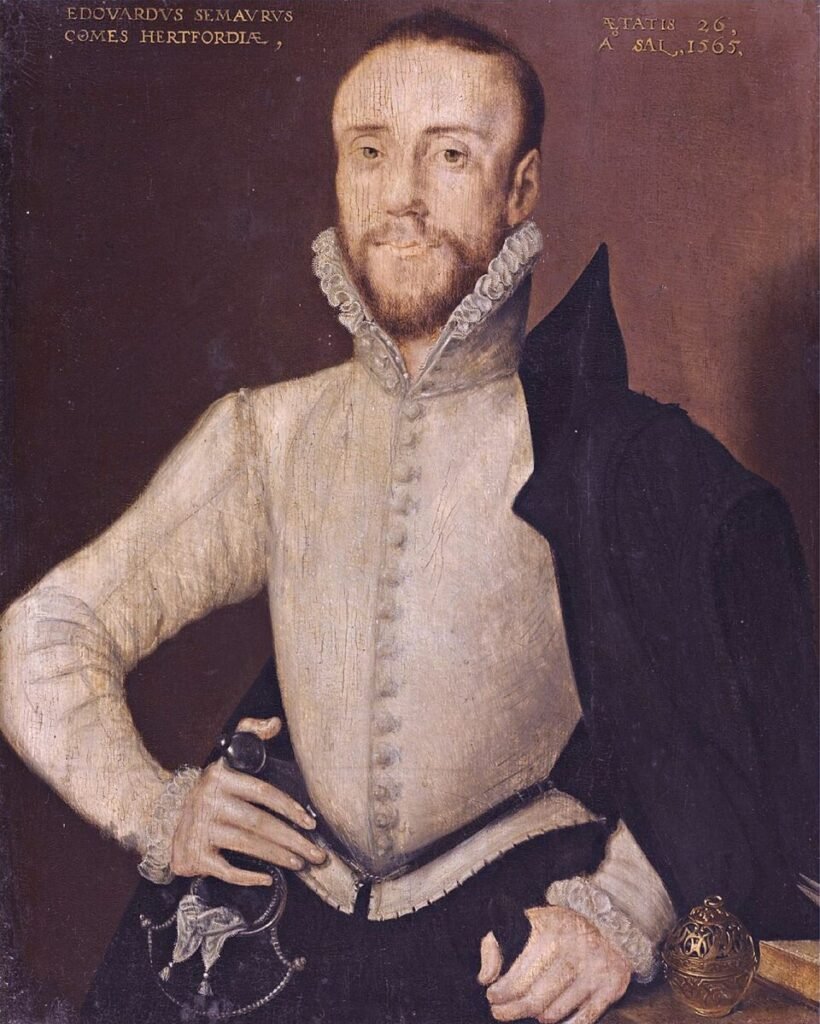
Edward Seymour, 1st Earl of Hertford, attributed to Hans Eworth
When Katherine’s pregnancy could no longer be disguised during the court’s summer progress in August 1561, a furious Queen Elizabeth I ordered both Katherine and Hertford to be arrested and committed to the Tower of London, placing them in separate towers.
Edward Seymour, Lord Beauchamp
On September 24, 1561, Katherine gave birth to her firstborn son within the stone walls of the fortress. The infant was baptized Edward in the Tower chapel of St Peter ad Vincula, the same chapel where his aunt Lady Jane Grey and both of his grandfathers had been buried following their executions.
Despite the reality of their incarceration, the initial accommodations provided to Katherine reflected her elevated royal standing. As Conor Byrne highlights:
“Katherine’s lodgings in the Tower were furnished with footstools and velvet cushions that had belonged to her great-uncle Henry VIII, alongside six pieces of tapestry, a bed of damask, two Turkey carpets, a chair of cloth of gold and a cushion of purple velvet.”
However, Queen Elizabeth I remained determined to delegitimize the newborn’s claim to her crown. An ecclesiastical commission headed by Archbishop Matthew Parker was appointed to investigate the validity of the marriage. Because the officiating priest could not be located and Lady Jane Seymour, the sole witness to the ceremony, had tragically died of tuberculosis, the commission ruled the marriage null and void, branding young Edward an illegitimate child.
Thomas Seymour and the Second Pregnancy
Despite their confinement in separate quarters, Katherine and Hertford managed to bribe their jailers, George and Dalton, while benefiting from the sympathy of the Lieutenant of the Tower, Sir Edward Warner. The couple met secretly in Katherine’s rooms on multiple occasions during May 1562.
When a second pregnancy was discovered later that year, Elizabeth’s anger reached unprecedented heights. The Earl of Hertford was summoned before the Court of Star Chamber and hit with a massive fine of £15,000 for the threefold crime of deflowering a virgin of the royal blood, breaking prison, and ravishing her a second time.
On February 10, 1563, Katherine gave birth to her second son, Thomas. As recorded in the contemporary diary of London citizen Henry Machyn:
“The x day of Feybruary was browth a-bed within [the] Towre with a sune my lade Katheryn Harfford, wyff to the yerle of Harfford, and the god-fathers wher ij warders of the Towre, and ys name was callyd Thomas.”
Image, Propaganda, and Family Separation
For English Protestants who lived in terror of a Catholic succession under Mary, Queen of Scots, Katherine Grey and her two sons represented the ideal native, Protestant alternative to the crown.
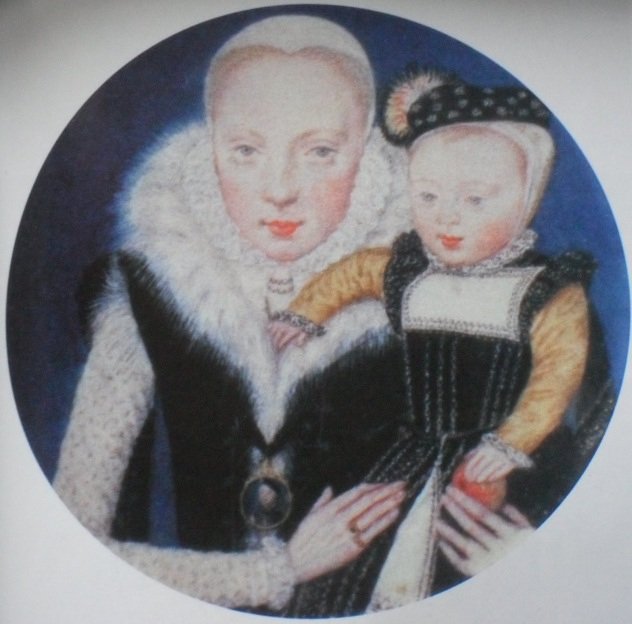
To build upon this sentiment, Katherine’s supporters utilized visual art as political propaganda. A famous portrait miniature painted by the Flemish artist Levina Teerlinc depicted Katherine holding her eldest son, Edward. As Conor Byrne observes:
“The image depicts the mother as Madonna carrying the Lord’s anointed, the future king of England, and copies of the portrait were made, probably to strengthen Katherine’s claim to the throne… The miniature was commissioned to commemorate the couple’s union, their offspring and the consequences of the marriage for the line of succession…”
Katherine Grey, Countess of Hertford with her eldest son Edward Seymour, Lord Beauchamp. c. 1562.
Fearing a deadly outbreak of the plague in London during the summer of 1563, Elizabeth permitted the family to be moved out of the Tower into private house arrest. However, the Queen ensured that the family was ruthlessly divided:
Edward (the elder son) was placed under the care of his paternal grandmother, the Dowager Duchess of Somerset, at Hanworth.
Thomas (the younger son) remained under house arrest with his mother at the estate of her uncle, Lord John Grey, at Pirgo in Essex.
Hertford was placed in separate custody elsewhere.
Katherine and Hertford were never allowed to see each other again. Katherine spent her remaining years in deep sorrow and depression, separated from her husband and elder child, until her untimely death at Gosfield Hall in January 1568 at twenty-seven years of age.
The Subsequent Lives of the Princes
Following the death of their mother in 1568, the two boys grew up under the supervision of the Seymour family and trusted guardians, forever marked by the stigma of illegitimacy imposed by Queen Elizabeth’s ecclesiastical commission.
The elder son, Edward Seymour, Lord Beauchamp, lived a life shadowed by his proximity to the crown. In a striking echo of his parents’ romance, he secretly married Honora Rogers in 1582 without his father’s initial approval, once again provoking royal irritation. Despite his official bastardy, many Protestant nobles continued to view Lord Beauchamp as the true legal heir to the English throne under the 1544 Act of Succession and Henry VIII’s will. Lord Beauchamp predeceased his father, dying in 1612, but his own son, William Seymour, would go on to marry Lady Arabella Stuart in yet another high-profile, unauthorized clandestine marriage of royal heirs during the reign of King James I.
The younger son, Thomas Seymour, maintained a much more quiet, private existence. He married Isabel Onley and lived away from the treacherous center of court politics, dying without heirs in 1600, shortly before the end of the Tudor era.
Conclusion and Historical Significance
The narrative of the children born in the Tower of London reveals the colder, pragmatic realities of Tudor dynastic statecraft. While Elizabeth I succeeded in neutralizing Katherine and her children during her lifetime, the legal arguments supporting the Suffolk line remained a source of intense debate for decades.
Under the strict terms of Henry VIII’s parliamentary will, Edward Seymour, Lord Beauchamp, was arguably the rightful heir to Elizabeth I when she died on March 24, 1603. Instead, political convenience led the English Privy Council to bypass the Tower-born candidate in favor of King James VI of Scotland.
As Conor Byrne concludes in the introduction of his biography about Katherine:
“According to the last will and testament of Henry VIII, when Elizabeth I died on 24 March 1603, she should have been succeeded by the 41-year-old Edward Seymour, Lord Beauchamp, eldest son of Lady Katherine Grey. Instead, upon Elizabeth’s death James VI of Scotland became the first Stuart king of England… While Katherine herself remains a somewhat obscure figure, her tragic story can be regarded as one of the most significant ‘what ifs’ in British history…”
Reference
Byrne, Conor.Lady Katherine Grey: A Dynastic Tragedy. Gloucestershire: The History Press, 2023.