A Summer of Royal Absence
In the summer of 1520 Henry VIII and Catherine of Aragon crossed the Channel to meet Francis I of France at the celebrated Field of the Cloth of Gold. Between the English-held town of Guines and the French town of Ardres a temporary city of tents, pavilions and wooden halls rose in a matter of weeks. Cloth of gold and silver, elaborate jousts, banquets that lasted for hours, and carefully staged masques turned the meeting into one of the most extravagant displays of royal magnificence in the early sixteenth century. Both kings brought large numbers of their nobility, household officers and servants. The English court that accompanied Henry and Catherine was so extensive that many of the great families of the realm were represented on the French side of the Channel.
Left behind in England was their only surviving child, the four-year-old Princess Mary. She remained at Richmond Palace under the supervision of her governess, Margaret Pole, Countess of Salisbury, and a household organised with the formality appropriate to a royal daughter. On 13 June 1520 the Lords of the Council wrote to the king in France to report that the princess was “daily exercising herself in virtuous pastimes and occupations.” The letter was intended to reassure an absent father, yet it also reflected the serious purpose that already surrounded the little girl’s daily life. Even at so young an age she was being prepared for a future of public duty, dynastic marriage and possible queenship.
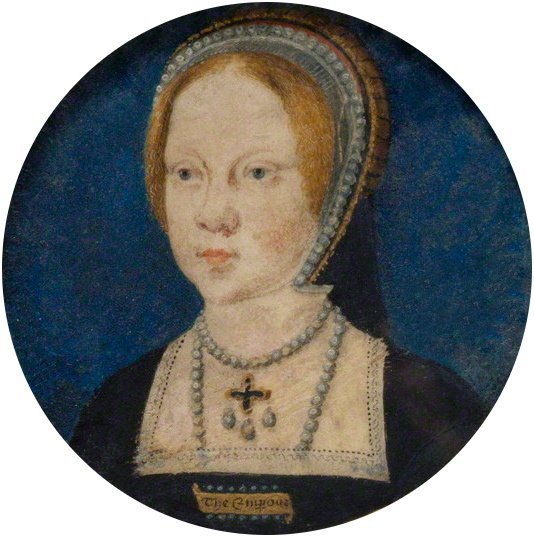
This is possibly the earliest surviving portrait miniature.
The inscription painted on her bodice, meaning ‘The Emperor’, probably refers to Mary’s engagement to the Emperor Charles V between 1521 and 1525.
The Decision to Leave Her Behind
Mary’s absence from the Field of the Cloth of Gold itself was deliberate. The great meeting had originally been planned for 1519, when there had been some expectation that the child might attend. When the encounter was postponed to the following year, the decision was taken to leave her in England. Several considerations may have influenced her parents. A temporary camp, however luxurious, was not an ideal environment for a young child. There were tensions at court between Queen Catherine and Cardinal Wolsey that made the atmosphere surrounding the expedition more complicated than usual. Perhaps most importantly, Henry and Catherine may have preferred to keep their daughter away from the intense scrutiny and political manoeuvring that would inevitably accompany any introduction to her prospective French in-laws.
Queen Claude of France, the plain but intelligent wife of Francis I and Mary’s prospective mother-in-law, had already sent gifts that included a jewelled cross worth six thousand ducats and a portrait of the dauphin. She was not rewarded with a sight of the child bride. The absence was noticed and may have caused some disappointment on the French side. It also left an opening for a more limited but still significant form of inspection.
An Unexpected French Delegation
Francis I was not prepared to leave the question of the princess’s health and appearance entirely unresolved. Before Henry VIII had even returned to England, the French king sent three of his gentlemen across the Channel with instructions to see Mary for themselves. The visit was unexpected. No lengthy formal notice had been provided, and the English authorities were obliged to arrange a suitable reception at short notice. The political and social establishment that had remained in England responded with impressive speed and coordination. The mayor of London banqueted the visitors. They were shown the principal sights of the capital. The Duke of Norfolk provided further entertainment. The entire episode demonstrated how much importance was attached to the young princess and to the alliance she still represented.
The purpose of the mission was practical and slightly sceptical. Francis wished to confirm that the child promised to his son was healthy, well formed and free from any physical or mental defect that English diplomacy might have concealed. Royal marriages were contracts of the highest political and financial value. A bride who proved unsatisfactory in person could undermine years of negotiation and damage the credibility of the sending court. The three French gentlemen therefore carried a discreet but serious responsibility: to observe the princess closely and to report on what they found.
The Audience at Richmond
On 2 July 1520 the visitors were brought to Richmond Palace for a formal audience with the princess. The occasion was arranged with as much ceremony as the limited warning allowed. In the presence chamber Mary appeared surrounded by an impressive company of the English elite who had not crossed to France. Beside her governess, the Countess of Salisbury, stood the Duchess of Norfolk and her three daughters, together with divers lords spiritual and temporal and several other titled ladies. The gathering formed a living demonstration of Tudor rank and solidarity around the small central figure.
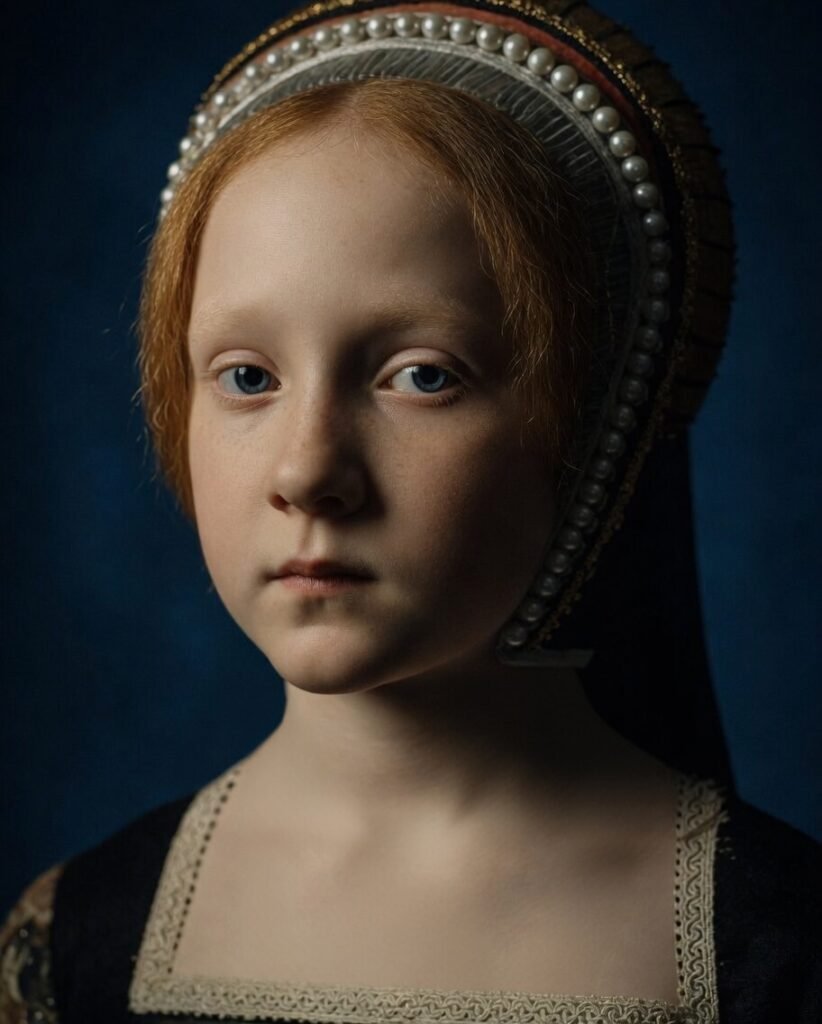
Mary handled the situation with a composure that struck observers as remarkable in a child of four. She entertained her visitors graciously, showing “the most goodly countenance, proper communication and pleasant pastime in playing at the virginals.” The ability to perform on the keyboard before foreign envoys was no trivial accomplishment at that age. It required both musical training and the self-possession necessary to appear in a formal diplomatic setting without awkwardness or fear. The French deputation left suitably impressed by what they had seen. After the audience they were offered further generous hospitality that included strawberries, wafers, wine and ypocras in plenty. The combination of ceremonial dignity and lavish refreshment completed a reception that had been organised with notable efficiency.
The Education Behind the Performance
The success of the Richmond audience did not occur by chance. Margaret Pole, Countess of Salisbury, had been chosen to supervise Mary’s upbringing because of her high rank, her experience of court life, and her reputation for virtue and intelligence. She understood the demands of royal etiquette and the importance of preparing a princess for public appearances. It is reasonable to suppose that she explained to the child who the visitors were and what would be required of her. She may well have rehearsed the necessary gestures, the proper expressions of courtesy, and the calm demeanour expected in such company. Mary’s ability to maintain a “goodly countenance” and to communicate appropriately reflected the disciplined education already under way in her household.
Music formed a central part of that education. From a very early age Mary displayed both talent and enthusiasm. Contemporary accounts record her delight in the playing of the Venetian organist Dionysius Memo, whom Henry VIII had brought to England not long after her birth. On one occasion the two-year-old princess had run after the musician calling “Priest, priest!” in an eager demand for more music. By the summer of 1520 she was capable of performing on the virginals with sufficient skill and composure to please diplomatic guests. The combination of musical accomplishment and formal manners allowed a four-year-old to meet the expectations of a royal audience and to leave a favourable impression on men sent to judge her.
The Wider Political Setting
The French inspection took place against the background of the still-active betrothal between Mary and the dauphin of France. The alliance had been arranged in 1518, when Mary was only two and a half years old. A proxy marriage ceremony had been held at Greenwich, during which the little princess, dressed in cloth of gold and a bejewelled black velvet cap, had played her part with suitable gravity while the bishop of Durham preached on the subject of marriage. At the time the match had appeared glorious. Yet the decision not to take Mary to the Field of the Cloth of Gold, followed by the dispatch of the three gentlemen, suggests a degree of residual caution on the French side.
Henry VIII’s own calculations were already beginning to change. By the end of 1520 he was increasingly concerned by French military pressure on the territories of Catherine of Aragon’s nephew, the young Emperor Charles V. Before the year closed he had begun to explore the possibility of a new betrothal for his daughter with the emperor himself. The visit of the French gentlemen therefore occurred at a delicate moment. The Anglo-French agreement remained formally in place, yet the political ground beneath it was shifting. Mary’s successful performance at Richmond helped to maintain appearances and to demonstrate that the English court could still present its princess with confidence even as her father prepared to consider other options.
A Child Drawn into Diplomacy
The episode at Richmond reveals how early a royal child could be drawn into the machinery of international politics. At four years of age Mary was already a figure of diplomatic interest, subject to inspection by foreign envoys and required to display the accomplishments and self-control expected of a future queen or queen consort. The presence of high-ranking English nobles and ladies transformed the reception into a collective assertion of Tudor prestige. The small girl at the centre of the gathering carried the weight of her parents’ dynastic hopes and of the alliance that still linked England and France.
Linda Porter observes that Mary’s behaviour was entirely appropriate to the occasion and a credit to herself, her parents and her governess. The French visitors departed impressed by the health, manners and accomplishments of the child they had been sent to examine. In the carefully managed performance of a four-year-old princess at Richmond, the elaborate world of sixteenth-century diplomacy found a living symbol of the marriage treaty that continued to bind the two crowns. The Field of the Cloth of Gold displayed the competing magnificence of two adult monarchs and their courts. The quieter audience at Richmond showed that even a child still in the nursery could be required to play her part in the same high-stakes contest of prestige, inspection and alliance.
Reference
Porter, Linda. The Myth of “Bloody Mary”: A Biography of Queen Mary I of England.